


‘Dostojee’ movie review: A heartwarming tale of friendship in times of bigotry
Think about experiencing life at its naked minimal, having fun with the smaller delights in opposition to all odds, unperturbed by exterior elements which were fuelling a local weather of concern. In director Prasun Chatterjee’s Dostojee, spiritual hatred engulfs a village the place a naked minimal life was lived to its fullest. The individuals within the village have been doing simply positive, in their very own world of struggles and survival; slow-paced, and much away from the epicentre of rising hate and fanaticism.
Dostojee
Director: Prasun Chatterjee
Forged: Arif Shaikh, Asik Shaikh, Jayati Chakraborty, Anujoy Chattopadhyay, Swatilekha Kundu
Runtime: 111 minutes
Storyline: Follows the story of two mates who dwell in a village perilled by spiritual hatred and unrest
Nature and mundaneness of life are captured at their finest cinematically, with practical lighting, color grading, sound, and close-ups of extraordinary faces and on a regular basis objects present in a living-on-the-edge family. Dostojee paints the glory of fireflies illuminating the darkish, a kite hovering excessive on a gray sky after which its fall from its grace (at least a metaphor for all times), the thrill of fishing with naked fingers in a village pond pounded by heavy rains, and the melancholy of a lone boat resting by the river. The realism all through the movie consistently remind its viewers of Bengali auteur, Satyajit Ray’s portrayal of the ephemeral nature of life, grief, and loss in a rural Bengal setting within the iconic Pather Panchali.
Prasun has a imaginative and prescient, and the movie takes a excessive ethical stand in the way it depicts poverty. It isn’t far faraway from actuality, and refuses to romanticise poverty. The characters are multifaceted, reeling underneath socially-challenging circumstances interspersed with brutal makes an attempt of polarisation on spiritual strains.
Whereas unfolding his story within the backdrop of a Hindu-minority village someplace on the India-Bangladesh border, director Prasun attracts a fast reference to the unrest that set off within the nation following the Babri Masjid demolition in Ayodhya and the chain of violence from thereon that brought about large upheavals within the early 90s. The socio-political narrative renders the movie intellectually wealthy because the characters consistently battle amongst themselves. That is after all excluding the protagonists of the movie — Palash (Asik Shaikh) and Safikul (Arif Shaikh) — who, until the tip, stay untouched by any form of ethical ambiguity and are oblivious to the raging hearth of communalism that’s slowly engulfing their soil.
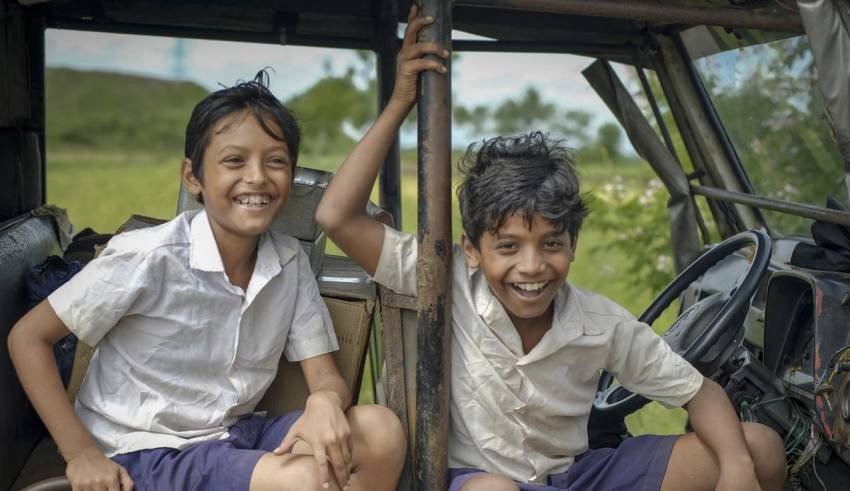
Palash, an academically-bright child with unwavering obedience, is the son of a Hindu priest. His bosom buddy and accomplice in mischief is Safikul, a son of a Muslim weaver, who lives within the adjoining home. Whereas the latter is not like Palash in training, he does have a artistic bone. Dostojee (which is a time period of endearment for a pal) tells the story of this inseparable duo. Whereas Safikul visits Ram Jatra along with his Hindu pal in opposition to his personal father’s needs, Palash shares along with his little sister the Eid-special semai that he will get from his fast neighbor-cum-confidante. Their households’ hesitancy to work together with one another as a result of their variations solely weakens in time, similar to the makeshift straw wall that goes between the 2 mud homes as a mark of boundary.
The movie additionally superbly captures Bombay’s affect in rural India in a number of scenes. For example, after wanting on the poster of Amitabh Bachchan’s 1975 movie Deewar, which is pasted on the wall of a bicycle restore store, they begin imitating senior Bachchan’s pose with the assistance of the shopkeeper. From taking photos whereas imitating their idol, to bunking lessons, to seeing a bioscope of the actor, the 2 interact in every kind of mischief. They prance round their picture-perfect lush inexperienced village; their thoughts is aware of no divides. They argue, make up and put on their very own hand-made crowns which can be illuminated with fireflies caught on the surface. They “battle like kings” ( rajader moto juddho), however their altercations by no means culminate in defeat or victory as their friendship isn’t outlined by the issues that locals within the village are principally involved about. Whereas one sect desires to construct a miniature Babri Masjid in retaliation to the massive mosque demolition, the opposite desires to reply again by organising a Ram Jatra on the event of putting in a Lord Ram idol in a neighborhood temple of Lord Shiva.
Prasun sparks a debate over a extremely spoken-about topic in up to date politics. Palash’s mom, frightened about dwelling in a communally unsettled space, asks her husband whether or not Lord Rama has ever been historically worshipped as a deity in Bengal. It could have been moderately fascinating for the viewers, had Palash’s father, as an alternative of a brief and crisp reply, elaborated on his understanding of Lord Rama’s recognition in Uttar Pradesh and past.
The nearly-two-hour function is sprinkled with a number of heartwarming moments that present the innocence of the rising up years and soul-stirring conversations that repeatedly posit that the human bond is above all the things. Take for instance, the second when an overwhelmed Safikul learns on the backstage of the Ram Jatra, that the people theatre artists aren’t actually foes in actual life, they usually play enemies on stage simply to earn a dwelling.
The movie is crammed with fairly just a few metaphors, and what can’t escape the viewers is the importance of the character of the native madman. You see him being pushed away by members of each communities. His belongings are thrown away and he’s faraway from his lair because the native Muslims need the land for constructing a mosque. He doesn’t get prasad at a Hindu pageant both. He stands as a powerful metaphor for individuals who are sometimes caught within the crossfire of sectarianism.
Palash and Safikul’s carefree childhood will get a beneficiant portrayal within the movie till tragedy strikes. However the second half of the movie lacks velocity and a way of storytelling too. As an alternative of additional strengthening the narrative, the writing begins to slack.
Regardless of that, the director manages to ship what he wished to in a moderately convincing method. What makes Dostojee distinctive is that a lot of the actors within the movie, together with the 2 protagonists, don’t come from an appearing background. Their pure expressions and dialogue supply make the characters all of the extra genuine, whereas they keep rooted in a movie that’s all about social realism.
Dostojee is presently working in theatres